|
|
|
Tucson Gay Museum®© - 1900's - 1910's 'A Look Back At Where We Have Been, Were We Are, And Where We Are Going'
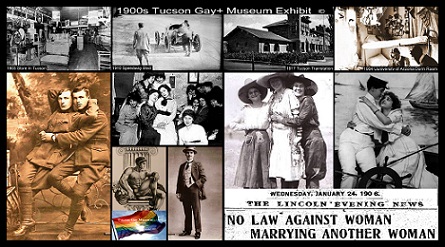
At the beginning of the 1900's, Tucson's population was 7,531 within the city's two (2) square mile area as a strange new trend swept through American girls' schools and a number of women's and other colleges including the University Of Arizona: an intense form of courtship, friendship, and relationship between girls known then as smashing. To do smashing, a girl would choose to devote herself to another girl in school, send her items of affection and perform simple small tasks for the person their affection was directed to. Then, when/if the girl being pursued finally did return this show of affection, she was then officially considered smashed by her peers. These school born relationships were often extremely intense and often continued well after high school and college in the form of romantic friendships. During the time they were referred to as ... Boston Marriages. Around Tucson Gays and Lesbians very discretely met and made new friendships at the Santa Rita Hotel's cafe by always asking to be seated on the west side of the room, and something new called Silent Moving Pictures could be seen downtown while an organist played.
Also, around Tucson after opening in 1907, both the inside and outside areas of the train depot (a.k.a. station) at 400 E. Toole Street downtown were very active pick up spots for locals. In the early 1900's lower, middle, and upper-middle class women could often live together as unmarried companions and arousing relatively little suspicion or interest from their neighbors. There were a number of prominent women including Jane Addams, a social reformer and co-founder of Hull House who spent almost all of her adult life living with Ellen Gates Starr who co-owned a home with her. This emerging style of relationships between women in the United States, as well as in Tucson was soon looked over closely by the ever more popular views of the sexologists worldwide. Many women would benefit from the work of the sexologists of the time as the word invert quickly allowed women with the more butch tendencies to very freely explore their masculine sides of themselves.
In the 1910's Tucson had grown to a city of 13,531 people. Traveling Vaudville Shows continued to perform regularly downtown attracting large diversion starved audiences as they passed through on their way to the bigger cities of the country. During this time period what would much later be known as the 4th Avenue Art's District area was the Barrio Tiburón (see article) which was known as one of two (2) of the city's red light districts, and regularly visited by Tucson's Gays & Lesbians of the time. In 1918 Tucson had established an aircraft hanger, and by 1919 had opened it's own airfield that went through the different names of Macauley Field (see article), Fishburn Field (see ariel view), Tucson Municipal Flying Field, and finally Mayse Field (named after the Mayse Air Servce Company) (see article) where later the Tucson Rodeo Grounds would be built at 4823 S. 6th Avenue. Returning army soldiers and marines from World War 1 1914-1918 who had been poison gassed by the German Military were flocking to new Veterans Hospitals like the Tucson area's original one (VA Hospital #51) that was purposely located very well away from the city's population thirteen (13) miles to the north of town off the dirt road heading to Oracle Junction on the former grounds of the privately owned Pastime Park (see article) which had been conveniently located just outside the jurisdiction of the Tucson city officials and police during its wildest days in the 1880's - 1890's (see 1800's) as a fun and pleasure center often frequented by Tucson's Gays, Bisexuals & Lesbians.
By the 1910's a few automobiles began showing up at the homes of the more well to do Tucson homes, however horses and wagons still filled the dirt streets and roads. Speedway Boulevard (see article) which had been originally widened for those watching and betting on each others horses to see who was the fastest was just beginning to feature a few of the new fangled contraptions racing down the boulevard as Gay's of the time discretely met there along the South Side of the dirt roads sidelines during the races and often same sex relationships formed as a result. It was a time when proper people went to Play's but the fun people went to watch the Vaudeville Acts (see exhibit) being performed live downtown in Congress Street area. When a circus visited workers and school children around town were let off for the day and businesses shut down so the whole town could go to the traveling circus with its clowns, animals, circus acts they offered everytime one arrived in town. Through the very early 1900's, as women's suffrage faced several important federal votes, a portion of the suffrage movement known as the National Women's Party and led by suffragette Alice Paul became the first cause to picket outside the White House. Due to that manner of protest that was not acceptable to authorities at the time, suffragists were subject to arrests, rape, beatings by both police and the public, and many were jailed where they again faced beatings, starvation, torture, along with random interrogations at all hours of the day and night. In 1918, Congress passed what became, when it was ratified by sufficient states the next decade, the Nineteenth Amendment, which prohibited all state and federal agencies from any gender based restrictions on voting.
Many of the returning World War 1 veterans migrating to the desert in 1918 with their war related poison gas lung problems including those infected with Tuberculosis soon set up a tent city out in the open desert just north of the present day University of Arizona (called Bugville or Tentville by Tucson townspeople). The conditions were a mixture of both harsh and squalid as the desert sand and hot winds swept thought every space of the flimsy hastily made tents and tar paper shacks. There same sex co-habitation was frequent, and others from Tentville intermingled at times with Gays & Lesbians from town.
As the 1910's came to a close in Tucson the population within the city had reached 19,982, and the year 1919 found both the nation and Tucson were right on the edge of a new era in human sexual relations. The country, and its younger generation had just experienced the world's first modern war with World War 1, and it was the first time airplanes flew overhead dropping hand thrown bombs out of their cockpits onto troops below, devastating machine guns killed hundreds of men in a matter of just minutes, tanks made their appearance, and poison gas had been used on United States and other soldiers. The country's and Tucson's mood was no longer on sacrifice, but instead it was firmly and directly focused on pleasure like the country had never seen before. Then, on January 16th, 1919 the unbelievable began happening. Under pressure from the Anti Saloon League, certain church groups especially the Methodists, and ladies societies around the country, the U.S. Congress began the process that in the decade just ahead would outlaw the manufacture and sale of alcohol to the public. That law in itself would set the stage for what would come. And what would come was the largest, wildest, and longest lasting party the nation had ever seen.
Publication of names, photos, exhibits, manuscripts, artifacts,
memorabilia of any person or organization in the TUCSON GAY MUSEUM is
not to be construed as indication of the sexual orientation of such
person(s), organization(s), advertisers, or any employees thereof.
This website is dedicated to all those of the Tucson LGBTQ Community that have come before, are here now, and will take our places in the future of Tucson, Arizona, U.S.A.
|