Tucson LGBT Museum  Tucson Gay Museum®©
Copyrighted  2012
Tucson LGBT Museum 


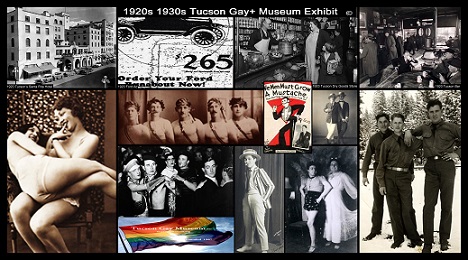
Tucson Gay Museum®© - 1920's & 1930's

'A Look Back At Where We Have Been, Were We Are, And Where We Are Going' 


'It's The Music, You Just Can't Stop Dancing' -  Tucson Lesbian Visiting The  Barrio Tiberon


1920's  Future Predictions
 
1920's - 1930's  Drag
 
1930's  New Year's Eve


Tucson LGBT Museum Exhibit
1920  Santa Rita Hotel
In Downtown Tucson
Tucson LGBT Museum Exhibit
1922 Around Town
Tucson LGBT Museum Exhibit
1924   Drag  King


The early 1920's in Tucson opened with a population of 20,092 within the city's 5.7 square mile limits and for many a new need emerged for the modern, the wild, the fun, the flamboyant, and the sexual after all the seriousness of the then gone World War 1 Period (see 1900-1910's) was soon left behind. Tucson and America suddenly felt rich, free of the old days, and wanted to party to show it. The 1920's in Tucson suddenly began to ROAR! However, in the somewhat conservative Tucson, the wild students from all around the big cities of the United States attending the UofA, and locals who loved a good time on the wild side contrasted sharply with the sometimes only outwardly appearing stalwart conservative leadership of Tucson.

Tucson LGBT Museum Exhibit
1923 Around Town
Tucson LGBT Museum Exhibit
1928 Around Town
Tucson LGBT Museum Exhibit
1926  Congress Street
Tucson


However, if you wanted fun on the wild side, there was no trouble finding it in the Old Pueblo of the 1920's. Even while alcohol was officially outlawed in the United States in what was termed by many as The Grand Experiment that actually took effect on a cold January 16, 1920, in Tucson the booze still flowed freely. Alcohol was being made in various size  stills and even in people's bathtubs from the campus of the University of Arizona, to the warehouses of the downtown area, to Congress Street area hotels, and right up to on top of Mount Lemmon. Considering that Nogales, Mexico was only 60 miles to the south, any kind of hard liquor, wine, or beer a person ever really wanted was easily available as loads of booze constantly made their way first up to Tucson for sale to it's residents, and then went on to hundreds of other U.S. towns and cities.

Tucson LGBT Museum Exhibit
1920's Popular Song
Tucson LGBT Museum Exhibit
1923 Congress Street
Men's Only Bar
Tucson LGBT Museum Exhibit
1925  Mixer Dance


Tucson's two red light Flesh & Fun districts of the time, one called the Barrio Tiberon  located in what would one day be called Tucson's 4th Avenue Arts District , and the other downtown just off of Congress Street were in full swing 24 hours a day, but after dark the intensity of the festivities often found few human boundaries. One such establishment,  The Prospector located just off   4th Avenue  was operated by a  Lesbian  known as  Choo Choo Clarissa for her unstoppable spirit who catered to Gays, Bisexuals, Lesbians, and any one else who liked watching or participating as the genders bended  at all hours of the day and night. The Music and Performances were live, the booze flowed freely, was often drank right out of each others shoes, and the smell of marijuana drifted through the air inside Choo Choo Clarissa's   pleasure house.

Tucson LGBT Museum Exhibit
1921 Around Town
Tucson LGBT Museum Exhibit
1921 Flying Field Tucson
Tucson LGBT Museum Exhibit
1924 University of Arizona Military
Cadets Enjoying Mt. Lemmon


Local  Tucson police and city officials were often not overly interested in enforcing a very unpopular federal law that split the nation and came from a Congress thousands of miles away back east in  Washington, D.C.  With the small size of Tucson at the time, there were seldom any of the only 1,520 Federal Prohibition Agents stationed around the United States in the city. Occasionally, small token raids might be carried out just to placate the federal officials, but they almost always turned out to be almost empty wharehouses or homes used as party places containing only a few bottles of hard alcohol to be confiscated just to show they had done something. Even the federal government itself did not always willingly enforce their own new ban on alcohol . Curiously and almost ironically, one of Tucson's most avid and vocal supporter of the local citizens right to drink alcohol during prohibition were the local Catholic Churches which maintained that the Federal Government did not have the right to define the morality of citizens. In yet another ironic twist the Ku Klux Klan strongly supported the outlawing of all alcoholic beverages throughout the entire United States for any reason.

Tucson LGBT Museum Exhibit
1923 The Tucson
Froggy Boys
Tucson LGBT Museum Exhibit 
1932 Around The University
of Arizona Tucson
Tucson LGBT Museum Exhibit
1930 University of Arizona
Students
Visiting  Puerto Peñasco

The federal law of the 1920's did have one interesting loophole however. Certain United States farmers (a garden in the back yard often counted) were allowed to make up to 200 gallons of wine or cider each year and large numbers of people began making their own alcoholic beverages at home. To do so, they often used bricks of wine, sometimes called blocks of wine. To meet the booming demand for grape juice, grape growers in California increased their growing areas over 700% in just the first five years of prohibition alone. The juice was commonly sold around Tucson as  bricks or blocks of Rhine Wine, blocks of port, and so on along with a warning: After dissolving the brick in a gallon of water, do not place the liquid in a large jug up in the cupboard for twenty days, because then it would turn into wine...... One enterprising grape block producer sold nine varieties: Port, Virginia Dare, Muscatel, Angelica, Tokay, Sauterne, Riesling, Claret and Burgundy.      

Tucson LGBT Museum Exhibit
1930 Downtown 
Tucson LGBT Museum Exhibit
1920 Congress Street Tucson
Tucson LGBT Museum Exhibit
1933 Around Town


  As the 1920's came to a close the heady this will never end mind set, borrowing binges, taking out personal, business, property, and other loans to buy highly inflated far over their values and often downright phony stocks by the public, business, large investors, trust funds, and even banks finally came home to roost on the morning of October 29th, 1929 when the stock market back in New York took a tumble that led to a roller coasting up and down whipsaw only ending in the stock market bottoming out finally in 1932 with 89% of its value having disappeared into thin air as the country's biggest depression  and  financial panic hit the entire country hard. Curiously, the home and property values of the time had already began their downward slide and had hit bottom four (4) years before in 1925.

Tucson LGBT Museum Exhibit
1922  Packard Newspaper
Ad Tucson
Tucson LGBT Museum Exhibit
1925 Gay Actor Ramón Navarro
In The Movie Ben-Hur
Tucson LGBT Museum Exhibit
1935 Chevrolet Newspaper
Ad Tucson

Although Tucson was a remote small town far away from the big cities of the United States, its population in early 1930 of 28,546 could not escape the Great Depression of the 1930's. Local banks closed their doors unable to return their depositors money and never reopened (at that time no FDIC Insurance existed and depositors were on their own if anything happened), many people employed in Tucson suddenly lost their jobs, property owners lost their properties unable to make the payments, some children ended up homeless on the hot dusty dirt streets of Tucson as parents could no longer feed or shelter them. In both of Tucson's   Red Light Districts the Gay, Lesbian, and Bisexual club owners and customers soon pitched in to cook up huge pots of stew containing any animal that strayed by and all the vegetables they could get their hands on or steal from Tucson's numerous small roadside Truck Farms located everywhere around the area. Hundreds and even thousands were fed in the 1930's by the very establishments and people that just a short time before they had turned their noses up at, regularly had the money at one time to frequent, or simply had no idea that a Gay or Lesbian had in some way made their one bowl of soup meal a day possible. Along the way on December 5, 1933  President Franklin Delanor Roosevelt signed the 23rd Amendment that repealed prohibition, and  Tucson was again officially wet.
Tucson LGBT Museum Exhibit
1932 Around University of
 Arizona
Tucson LGBT Museum Exhibit
1936 Around Town
Tucson LGBT Museum Exhibit
1934 Santa Rita Hotel
 Downtown Tucson

That Great Economic Depression of the 1930's at the time did however bring all men and women in the Old Pueblo even closer together than they had been before. Out of that lasting bonds, friendships and at times same sex relationships were formed that flourished well into the future decades. Meantime, around Tucson the Pioneer, Congress, Mac Arthur, and Santa Rita  hotels cafe's-restaurants and only a very few bars continued to be discrete places for Gays-Lesbians to meet if you knew which side of the room to be seated at, and at what times to go as long as you were totally discrete at all times when there. As the decade ending in 1939 came to a close in Tucson with 35,236 people living within the 7.7 square mile city limits. Gone (or almost) were horses-wagons on the streets of Tucson, Vaudeville Acts as Moving Pictures and Radio took over, ice delivery's for the ice box a.k.a. refrigerator, confidence in banks, making your families clothes at home, buttons started going out as zippers finally became accepted, 10 cents a gallon gasoline, dressing very young boys in girls clothes a.k.a. Breeching to name but a few. The earliest known recipient of a Male to Female Sex Reassignment Surgery was Lili Elbe in Berlin, between 1930 & 1931. The operation was started with the removal of the male sex organs and performed by Dr. Magnus Hirschfeld. The patient Lili Elbe went on to have four more subsequent operations that included a last unsuccessful ovarian transplant which resulted in her death.

All around America there was a feeling of hope for a better future just around the corner going into the next decade. That feeling was being reinforced, and at times created by the President  Franklin Delanor Roosevelt during his weekly Fireside Chats to the public heard over the radio in most people's homes and in public places. Unfortunately, here and there in the latter 1930's early newspaper articles began mentioning the  Japanese Imperial Military had marched into China (see video) (see video) after starting in 1931 in Manchuria and a full attack later on China  July 7, 1937 (see video) (see video) while both the German & Russian Armies had marched into Poland on September 1, 1939. Many of the people and those in the government of the United States still remembered the last War To End All Wars it had sent it's young men and nurses over to the war in 1915 (see 1910's-1900's)  and wanted no part of going Over There into someone elses problem again anytime soon. However, like a volcano, if rumblings are a warning sign often leading up something bigger, the Gays & Lesbians of the time period would surely figure right into it along with everyone else in many ways.  
      
Tucson LGBT Museum Exhibit
1939 Tucson Citizen
Advertisement
Tucson LGBT Museum Exhibit 
1929-1930 Banking Panic
Run On Banks
Tucson LGBT Museum Exhibit
1939 Gay Porn Photo
Tucson LGBT Museum Exhibit
1924 Newspaper Ad Tucson
Tucson LGBT Museum Exhibit
1927 Charles Lindburg In Tucson
Tucson LGBT Museum Exhibit
1931 Hotel Congress Tucson
Tucson LGBT Museum Exhibit
1931 Stone Avenue Tucson
Tucson LGBT Museum Exhibit
1934 Phone Operators Tucson
Tucson LGBT Museum Exhibit
1920's  Phone & Radio
Tucson LGBT Museum Exhibit
1930 Mickey Mouse
Button  Tucson
Tucson LGBT Museum Exhibit
1925 Drugstore's Soda
Fountain
Tucson LGBT Museum Exhibit
1931 Sound Recording
 Machine
Tucson LGBT Museum Exhibit
1932 Newspaper Ad Tucson
Tucson LGBT Museum Exhibit
1934 Plymouth Car Ad Tucson
Tucson LGBT Museum Exhibit
1933 Kitchen Tucson
Tucson LGBT Museum Exhibit
1928 Pioneer Hotel Room
 Key Medallion Tucson
Tucson LGBT Museum Exhibit
1933 Home Entertainment
Center Tucson
Tucson LGBT Museum Exhibit
1935 Pioneer Hotel
Downtown Tucson


Publication of names, photos, exhibits, manuscripts, artifacts, memorabilia of any person or organization in the TUCSON GAY MUSEUM is not to be construed as indication of the sexual orientation of such person(s), organization(s), advertisers, or any employees thereof.


This website is dedicated to all those of the Tucson LGBTQ Community that have come before, are here now, and will take our places in the future of Tucson, Arizona, U.S.A.